Why Won’t My Garage Door Close? 10 Common Causes & Fixes
Last updated: January 20, 2025 | 7 min read
It’s a frustrating scenario: you’re leaving for work, you hit the garage door button, and… nothing. Or worse, it starts to close, reverses, and goes back up. Before you panic, check these 10 common reasons why your garage door won’t close. Many are simple DIY fixes!
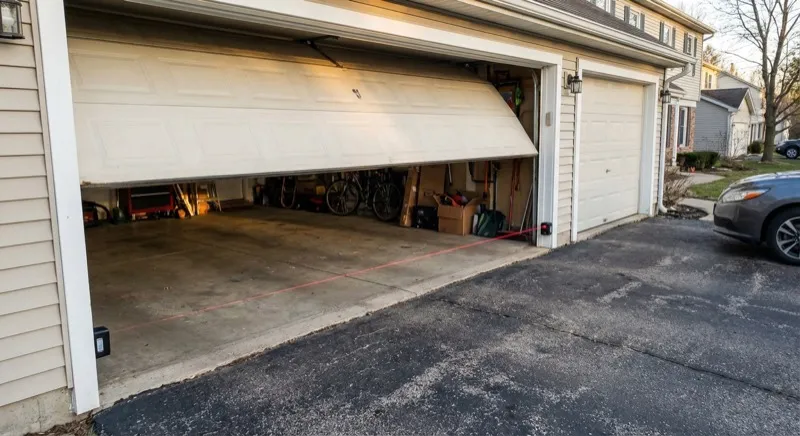
1. Safety Sensors Are Blocked or Misaligned (Most Common!)
The Symptom: The door starts to close, stops, reverses to the open position, and the opener lights flash 10 times.
The Cause: Since 1993, all garage door openers must have safety sensors (the little “eyes” near the floor on both sides). If something blocks the beam or they aren’t pointing at each other, the door won’t close for safety.
The Fix:
- Check for obstructions (leaves, toys, cobwebs) in front of the sensors.
- Check if the LED lights on both sensors are glowing steadily.
- If one is blinking or off, loosen the wing nut and adjust it until the light stays solid.
- Clean the lenses with a soft cloth.
2. Lock Mode is Engaged
The Symptom: The door won’t close from the remote, but might work from the wall button (or the wall button light is blinking).
The Cause: Someone accidentally held the “Lock” button on the wall control console, disabling all remotes.
The Fix: Press and hold the “Lock” button on your wall console for 3 seconds to disengage it. The indicator light should stop blinking.
3. Dead Remote Batteries
The Symptom: The door closes fine from the wall button but not from your car remote.
The Cause: The battery in your remote is dead.
The Fix: Replace the battery (usually CR2032 or similar). It’s a $5 fix that solves 20% of service calls!
4. Disconnected Garage Door Opener
The Symptom: The motor runs, but the door doesn’t move. Or the door moves manually but not with the opener.
The Cause: The emergency release cord (the red rope) was pulled, disconnecting the trolley from the opener carriage.
The Fix:
- Close the door manually.
- Pull the red cord toward the door (not down) to re-engage the spring clip.
- Lift the door manually until you hear a “click” or run the opener until it reconnects.
5. Track Obstructions or Damage
The Symptom: The door stops or binds at a specific spot on the tracks.
The Cause: A bent track, a loose bolt blocking the roller, or debris in the track.
The Fix:
- Visually inspect the vertical and horizontal tracks.
- Clear any debris.
- If a track is bent, call a professional. Hammering it out often makes it worse.
6. Broken Springs or Cables
The Symptom: The door is extremely heavy, won’t move, or you heard a loud “bang.”
The Cause: A broken torsion or extension spring. (See our guide on Diagnosing Broken Springs).
The Fix: STOP. Do not attempt to close the door with the opener. Call a professional immediately. This is dangerous.
7. Limit Settings Need Adjustment
The Symptom: The door closes all the way and then immediately reverses back up.
The Cause: The opener thinks the door has hit an object because the “close limit” is set too far down, making the door push too hard against the floor.
The Fix:
- Locate the “Limit” adjustment screws or buttons on your opener motor.
- Adjust the “Down” limit slightly (turn it towards “Less” or ”-”).
- Test and repeat until the door closes gently without reversing.
8. Stripped Gears in the Opener
The Symptom: The motor makes a humming or grinding noise, but the chain/belt doesn’t move.
The Cause: The internal plastic gears inside the motor unit have stripped due to age or excessive strain.
The Fix: You need a gear replacement kit or a new opener. This is an intermediate DIY job or a prompt pro repair.
9. Power Source Issues
The Symptom: No sound, no lights, nothing works.
The Cause: The opener is unplugged, the circuit breaker tripped, or the GFCI outlet popped.
The Fix:
- Check if the opener is plugged in.
- Check your breaker panel.
- Press the “Reset” button on the wall outlet (GFCI).
10. Cable Snapped or Off Drum
The Symptom: The door is crooked or hanging unevenly.
The Cause: A lift cable has snapped or come off the cable drum.
The Fix: Call a professional. Cables are under high tension connected to the springs. Do not attempt to cut or move the cables yourself.
When to Call a Professional
If you’ve checked the sensors, batteries, and locks, and the door still won’t close, it’s time to call the experts.
Call Ez2Fix if:
- You suspect broken springs or cables.
- The tracks are bent.
- The opener is making grinding noises.
- The door is off its tracks.
We offer same-day repair in Northern NJ to get your home secure again quickly.
Call (201) 554-6769 for prompt service.
Related Articles: