
How to Lubricate Your Garage Door: A Complete Maintenance Guide
Last updated: January 25, 2025 | 6 min read
A noisy garage door isn’t just annoying—it’s a cry for help. Squeaking, grinding, and rattling are signs of metal-on-metal friction that accelerates wear and tear. The good news? You can silence your door and extend its lifespan by years with a simple 15-minute maintenance routine.
Here is the professional guide to lubricating your garage door properly.
Why Lubrication Matters
Your garage door is the largest moving part of your home. It has dozens of moving metal parts that grind against each other thousands of times a year. Without lubrication:
- Parts wear out faster: Metal shavings appear, and hinges/rollers fail prematurely.
- Opener strain: Friction makes the door heavier, forcing your opener motor to work harder and burn out sooner.
- Noise: The screeching sound is literally metal being ground away.
What You Need (and What to Avoid)
✅ USE THIS:
- Lithium-based Grease (Spray): White lithium grease is ideal because it adheres to metal, withstands temperature extremes, and doesn’t attract dust.
- Silicone Spray: High-quality silicone spray is also excellent, especially for weatherstripping.
- Garage Door Lube: Specialized sprays (like Blaster Garage Door Lube or 3-IN-ONE) are formulated specifically for this purpose.
❌ AVOID THIS:
- WD-40 (Standard): Standard WD-40 is a solvent/degreaser, NOT a long-term lubricant. It will clean the parts but then strip away existing grease, making the problem worse later.
- Grease Gun / Thick Grease: Unless you have a commercial door, thick grease attracts dirt and grit, turning into a grinding paste.
- Oil: Engine oil is messy and drips.
Step-by-Step Lubrication Guide
Frequency: Perform this maintenance every 6 months (Spring and Fall).
1. Close the Door and Disconnect the Opener
Start with the door closed. Pull the red emergency release cord so you can move the door manually if needed (and to prevent the opener from activating while you work).
2. Clean the Tracks (DO NOT LUBRICATE)
Important: Do not lubricate the tracks! Grease in the tracks attracts dirt which gums up the rollers.
- Wipe the inside of the tracks with a rag and brake cleaner or simple household cleaner.
- Remove any cobwebs or debris.
3. Lubricate the Springs (The Most Important Part)
The springs do the heavy lifting.
- Spray a generous amount of lubricant along the entire length of the torsion springs (above the door).
- If you have extension springs (on the sides), lubricate them too.
- Let it soak in. The oil reduces friction between the coils as they wind and unwind.
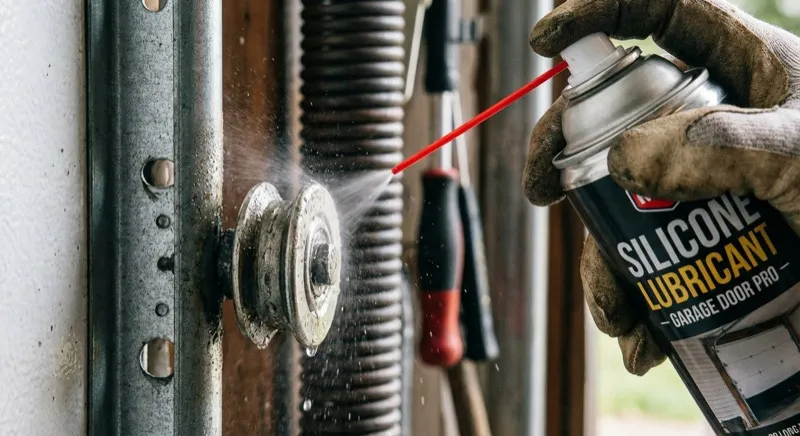
4. Lubricate the Rollers
- Steel Rollers: Spray the ball bearings inside the roller.
- Nylon Rollers (Black/White wheels): Only lubricate the steel bearings in the center. Do not spray the nylon wheel itself, as it can degrade the plastic.
- Sealed Rollers: If you have high-end sealed rollers (no visible bearings), they don’t need lubrication.
5. Lubricate Hinges and Pivot Points
Spray the pivot points of every hinge where the sections of the door bend.
- Don’t forget the hinges on the sides that hold the rollers.
- Wipe away excess drips with a rag.
6. Lubricate the Bearing Plates
At the top of the door, on both ends of the spring bar (torsion tube), there are circular bearing plates. Spray these to ensure the shaft spins freely.
7. Lubricate the Lock and Armbar
If you have a manual lock, spray a little lube into the keyhole and on the locking mechanism bars (if visible inside).
8. The Opener Rail (Chain or Screw Drive)
- Chain Drive: Spray the chain sparingly to prevent rust and reduce noise.
- Screw Drive: Use a lithium grease (often comes in a tube) specifically for screw drives.
- Belt Drive: Do not lubricate the belt. It requires no maintenance.
9. Weatherstripping
Spray a little silicone spray on the bottom rubber seal and the PVC weatherstripping around the door frame. This keeps the rubber flexible and prevents it from sticking to the door in freezing weather.
Testing Your Work
- Re-engage the opener by pulling the cord toward the door and lifting the door until it clicks.
- Run the door up and down a few times to distribute the lubricant.
- Listen. It should be significantly quieter!
When Lubrication Isn’t Enough
If your door is still making loud grinding noises after lubrication, you might have:
- Worn out rollers (wobbly wheels)
- A frayed cable
- A balanced issue (springs losing tension)
- Bent tracks
In these cases, lubrication is just a band-aid. You need a professional repair.
Contact Ez2Fix at (201) 554-6769 for a comprehensive multi-point safety inspection and tune-up. We’ll get your door running like new.
Related Articles: